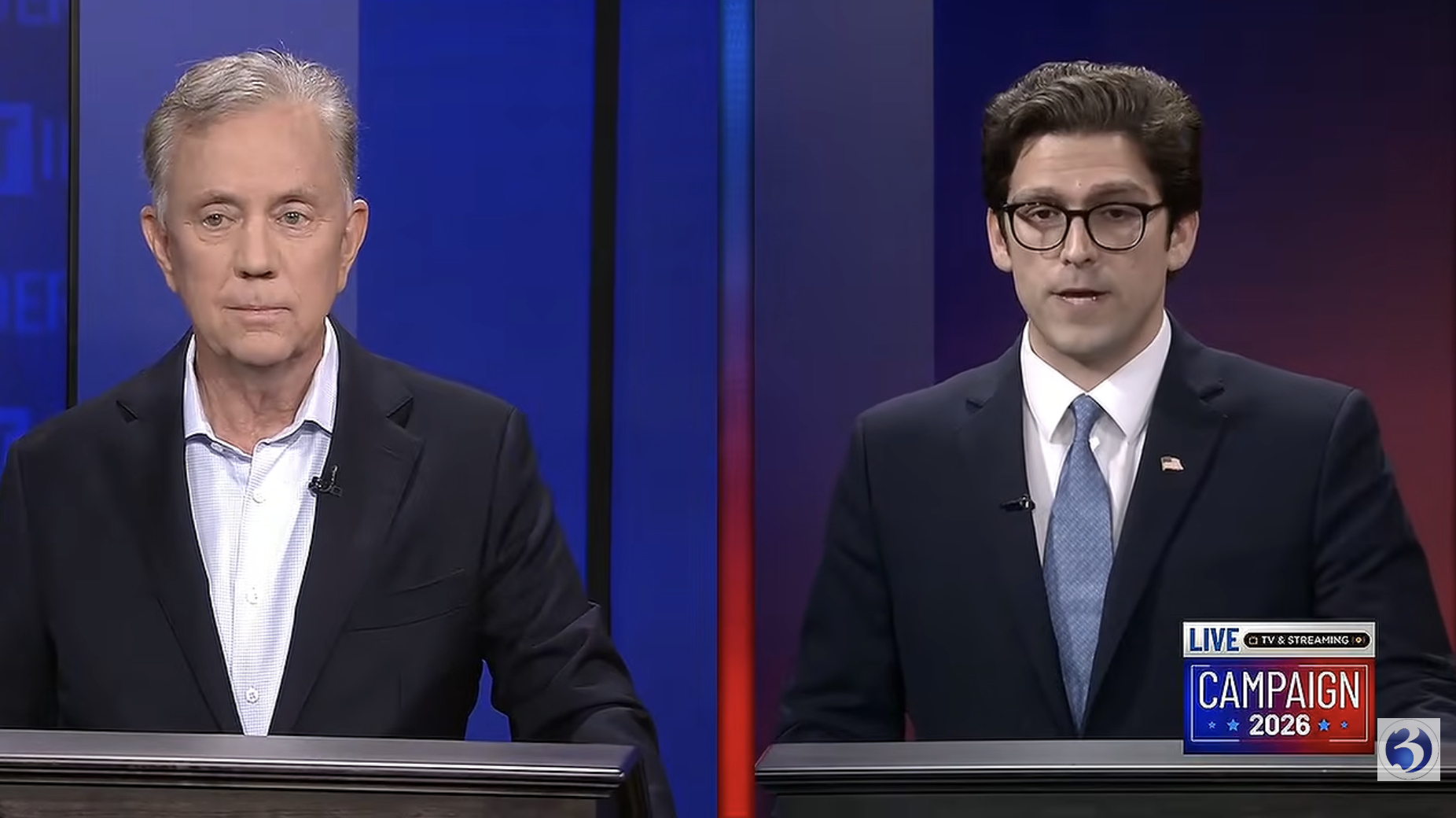
State Sen. Ryan Fazio of Greenwich and Gov. Ned Lamont debated taxes and electric bills during their first televised debate Thursday, Oct. 22, as they campaigned for governor.
The hour-long face-off at WFSB's Rocky Hill studio, co-hosted by CT Insider and WFSB-TV Channel 3, aired at 7 p.m. WFSB anchor Erin Connolly moderated, with WFSB chief political reporter Susan Raff and CT Insider columnist Dan Haar as panelists.
Fazio, 36, opened by accusing Lamont of raising taxes by $3 billion over eight years and leaving Connecticut with some of the nation's highest energy costs and tax burdens. Lamont, 72, a two-term Democrat seeking a historic third term, countered by citing eight balanced budgets and income tax cuts he signed for middle-class families, working households and seniors.
The sharpest exchange came over Fazio's proposal to suspend the state's 25-cent-per-gallon gas tax. Fazio said the state's transportation fund surplus could cover the cost. Lamont called the idea insufficient, noting gas prices had jumped $1.75 per gallon due to the war in Iran and Trump administration tariffs.
"That's just the type of political thinking that got this state into trouble," Lamont said, according to CT Mirror.
Fazio also targeted Lamont's relationship with Eversource, citing text messages between the governor and CEO Joseph Nolan Jr. first reported by CT Insider. Fazio called the relationship "cozy" and pledged to cut electric bills by 20 percent. Lamont denied the characterization.
The candidates traded barbs over state corruption. Fazio argued that wrongdoing had flourished under Lamont's leadership. Lamont pointed to the case of former deputy budget official Kosta Diamantis, who fled to Greece before being sentenced on 21 federal felony counts, and said he holds officials accountable.
On immigration, Lamont accused Fazio of supporting Immigration and Customs Enforcement (ICE) operations and opposing efforts to keep federal agents out of schools and churches. Fazio said he opposed those restrictions because he considered them ineffective, not because he backs aggressive enforcement. He pivoted to public safety and affordability.
Both candidates voiced opposition to artificial intelligence data center tax breaks and Flock license-plate cameras, though they disagreed on how to restrict each.
The tax dispute carried into post-debate spin sessions. Fazio clarified that his $3 billion figure was cumulative, averaging about $412 million annually. That accounting includes $500 million collected yearly through a 0.5% payroll tax funding the Paid Family and Medical Leave program, CT Mirror reported. Lamont disputed the figure entirely. The two sides disagree on whether delayed or canceled tax cuts count as increases.
Polls heading into the debate showed Lamont with a commanding lead. A Sacred Heart University/WFSB/CT Insider poll found Lamont at 53% to Fazio's 31% among registered voters, according to CT Insider's pre-debate analysis. Among likely voters, the gap widened to 59%-33%.
Fazio, who cast his early ballot at Greenwich Town Hall on Oct. 19, has acknowledged the deficit. He told reporters that day that his campaign is "the underdog," according to WTNH.
A second and final debate is set for 7 p.m. Tuesday, Oct. 27, at Mohegan Sun on WTNH, Channel 8. Early voting runs through Nov. 1, with Election Day on Nov. 3.