Democratic state Senate candidate Jill Oberlander has publicly opposed the proposed 176-unit development at Western Junior Highway in Greenwich's Byram neighborhood and called for changes to Connecticut's 8-30g affordable-housing law.
In a letter published Tuesday, Aug. 18, Oberlander said she opposes the six-story project and argued that local zoning officials, not state government, should drive development decisions.
"Hartford shouldn't dictate development without adequately accounting for what individual neighborhoods can handle," Oberlander wrote.
The proposed development
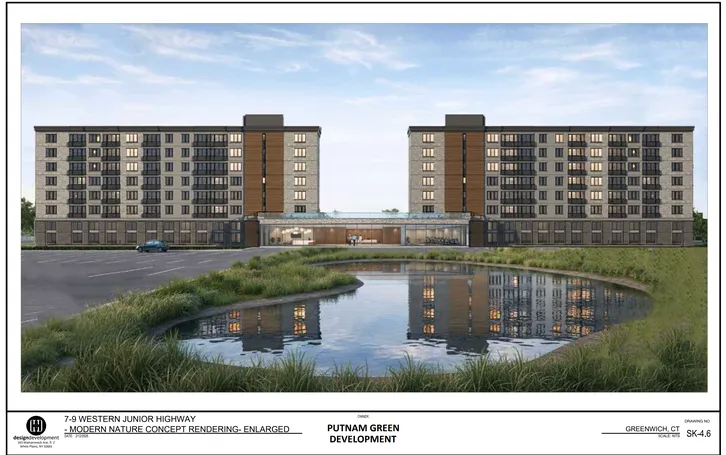
The proposal would replace the existing 66-unit Putnam Green apartment complex at 7 and 9 Western Junior Highway, built in 1976, with two six-story buildings containing a total of 176 studio, one-, two- and three-bedroom units and approximately 200 parking spaces, according to pre-application documents submitted by the developer's attorney, John Tesei, as reported by Greenwich Time. Thirty percent of the units would be designated affordable.
The plan exceeds the site's current zoning limits in multiple ways: the zone permits four stories and 85 residential units, while the proposal calls for six-story structures and 176 units. The developer is seeking approval under 8-30g.
What the law does
Connecticut's 8-30g law, enacted in 1989, creates a special affordable-housing land-use appeals procedure. In municipalities where less than 10% of the housing stock qualifies as affordable under the statute's specific categories, the law changes the burden of proof when a developer appeals a local zoning commission's decision. If a qualifying application is denied, the commission must demonstrate that its action is necessary to protect substantial public interests in health, safety or other matters it may legally consider, and that those interests outweigh the need for affordable housing.
The local Planning and Zoning Commission still reviews the application. The law does not bypass that review. It changes the legal framework under which certain commission decisions can be challenged on appeal.
According to CT Insider, 31 of Connecticut's 169 municipalities met the law's 10% threshold and were exempt from the 8-30g appeals procedure as of 2025. That is the same number as in 2002. Greenwich is not among them.
Oberlander's argument
Oberlander points to that figure as evidence the policy should be reconsidered. "When more than 80% of our communities cannot meet a standard, it's time to ask whether the policy needs to change," she wrote.
She argued that local planning and zoning officials understand a town's roads, sewers and infrastructure better than state government does, and called for the state to provide resources so communities can build affordable housing in locations their own officials deem appropriate. In her letter, Oberlander also raised concerns about traffic, congestion, infrastructure capacity, wetlands and greenspace at the site.
The policy rationale and local precedent
The 1989 law was designed to address local barriers to affordable housing by creating the special appeals process for qualifying developments. Affordable units approved under 8-30g must be deed-restricted for 40 years.
A recent Greenwich case illustrates how local authority operates under the law. A Superior Court judge upheld the Planning and Zoning Commission's approval of the Mason Street 8-30g development in a ruling around Aug. 10, rejecting a developer's challenge to conditions the commission imposed, including requiring affordable units to be at least 90% the size of comparable market-rate units. P&Z Commission Chairwoman Margarita Alban said the decision "validates our commitment to advancing inclusive, equitable affordable housing."
Greenwich context
Oberlander's position aligns with broader local concerns about state housing mandates. On July 24, a bipartisan coalition of municipal and state officials gathered at Greenwich Town Hall to call for a moratorium on state housing mandates pending infrastructure assessment. The group included First Selectman Fred Camillo, state Sen. Ryan Fazio and state representatives from Greenwich, Darien and New Canaan. The coalition cited gas and water utility capacity constraints.
"We can expand access to affordable housing. We can make our state more affordable and we can respect local control in the process … But we need a real change in direction and policy in order to meet that," Fazio said at the July 24 event, as reported by the Greenwich Sentinel.
Fazio is not seeking reelection to the state Senate as he runs for governor, leaving the 36th District seat open to Oberlander and Republican candidate Joe Kelly.
Former Greenwich Selectman Lin Lavery, who works in real estate, criticized the scale of the Western Junior Highway proposal in Greenwich Time's reporting. "Six stories? That doesn't make any sense....That's huge, too much," Lavery said.
Project status
Bedford Realty Associates purchased the Putnam Green site for $20.7 million. Tesei's pre-application documents were submitted to the Planning and Zoning Commission on Aug. 17. As of that date, no preliminary review by the commission had been scheduled. The next step is for the commission to schedule a hearing on the application.