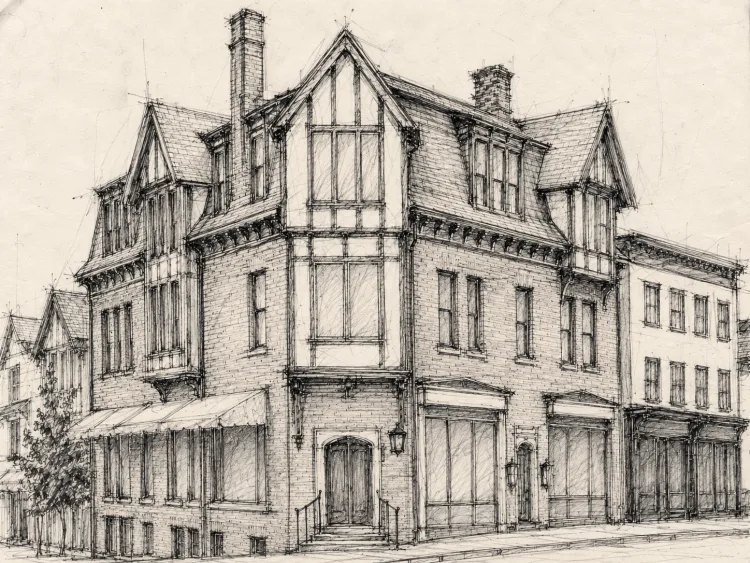
Connecticut's State Historic Preservation Office has opened a formal investigation into the proposed demolition of the Tudor Revival buildings at 2 Greenwich Avenue, creating a legal pathway beyond the Historic District Commission's 90-day delay power that could block the teardown of the National Register-listed corner building.
Frederick Lee, chairman of Representative Town Meeting District 1, said in a published statement Friday, July 17, that he received written notice from SHPO confirming the office "will begin its investigation" of the proposed demolition. The move follows letters sent Wednesday, July 15, by First Selectman Fred Camillo to both SHPO and Connecticut Attorney General William Tong urging state intervention.
Greenwich Avenue Properties LLC and MBMB Greenwich LLC, backed by New England Investment Partners executive Jonathan Marcus, have proposed demolishing the corner building and two adjoining structures at 10 Greenwich Avenue and 10-12 West Putnam Avenue. The plan calls for replacing them with a four-story mixed-use development featuring ground-floor retail and 14 residential units, according to the developer's application.
The corner building, originally erected in 1878 and remodeled in the Tudor Revival style in 1910, sits within the Greenwich Avenue Historic District on the National Register of Historic Places. That federal listing, however, does not prevent a private owner from tearing it down. The property also lacks a local Historic Overlay Zone, which would give the town stronger authority.
"P&Z can't stop this demolition," Planning and Zoning Commission Chair Margarita Alban said. "We are all looking to what state law can do at this point."
Under Connecticut General Statutes Section 22a-19a, any individual or entity can seek legal recourse to stop the "unreasonable destruction" of a National Register property. SHPO's investigation will include contacting the property owner, scheduling a site visit, and engaging a structural engineer or historic architect through Preservation Connecticut, according to the state's published process guidelines. If no compromise is reached and SHPO staff determines an alternative to demolition exists, the office can bring the matter before the Historic Preservation Council, which meets the first Wednesday of each month. The council can then request the Attorney General's Office to intervene.
The developer has argued in application documents that more than a century of renovations left the building's structure in a condition that "renders conventional rehabilitation impractical." The developer's application narrative states the replacement "will not be a facsimile" of the original.
The zoning relief sought is substantial. According to Camillo's letter, the proposal requests a partial fourth story in the three-story CGBR zone, a parapet height of approximately 52 to 53 feet, and a floor area ratio of 4.06.
At the Historic District Commission's Wednesday, July 8, meeting, residents submitted more than 20 opposition letters. Commission members said they had received no formal application and had not reviewed the replacement design. The commission cannot reject a demolition permit but can request a 90-day delay. Historic District Commission Secretary Andrew Melillo said the commission also plans to discuss preservation incentives with the property owner, including the possibility of a historic overlay zone designation.
The Planning and Zoning Commission will hold a nonbinding pre-application review on Tuesday, July 21. Residents can watch via Zoom or register to speak; details are available through the Planning and Zoning Department at 203-622-7894. Comments on the SHPO investigation can be sent to [email protected]; comments to the Attorney General's Office go to [email protected].