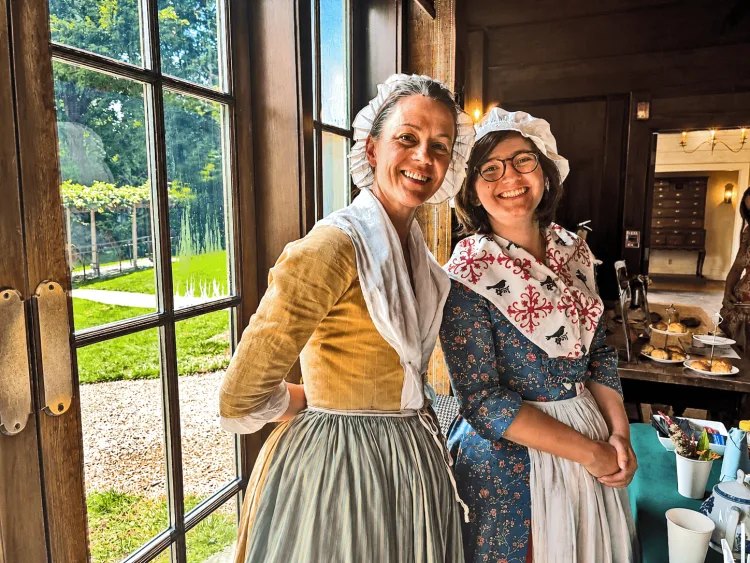
Families can try on colonial-era clothing and learn how people dressed 250 years ago at the Greenwich Historical Society's "Dress for 1776" program on Thursday, August 13, from 2 to 3 p.m. at the society's Strickland Road campus in Cos Cob.
Melissa Houston, the Historical Society's director of education, will lead the hands-on session using reproductions and period materials to show how garments were constructed, what layers a Connecticut woman wore in 1776, and why clothing carried social and political meaning beyond appearance. Participants will have a chance to try on colonial-style clothing and sample historically inspired tea.
Houston holds a master's degree in history and spent more than a decade in collections management and public history after starting her career as a high school social studies teacher. She also serves on the Schools and Education Committee of the town's America's 250th Greenwich Commission, according to commission records.
The program draws on the society's current exhibition, "Fashioning America: 250 Years of Greenwich Style," which opened April 22 and runs through January 10, 2027. The show spans seven installations covering clothing from the Revolutionary War era to the present, with many pieces exhibited publicly for the first time.
Senior Curator Kathleen Craughwell-Varda said when the exhibition opened in April that "Greenwich's proximity to New York City always made the best goods and fashions available to its residents."
That proximity is part of the historical backdrop the program will explore. As the Greenwich Sentinel reported, Greenwich's coastal location connected local households to merchants selling imported textiles, ribbons, buttons, and shoes through Atlantic and regional trade. When British forces occupied New York City in 1776, those routes were disrupted, raising the value of fabric and clothing already in local homes.
The consequences rippled through daily life. Wearing homespun became a political statement in support of boycotts, and women's work as spinners, weavers, and seamstresses grew critical to both military supply and household survival. Sewing machines, zippers, snaps, and standardized paper patterns did not exist. Every garment was measured, cut, fitted, and stitched entirely by hand.
Tickets are $15 for Historical Society members and $20 for non-members. Each ticket covers one registrant, and children must be accompanied by an adult. Registration details are available at greenwichhistory.org.
Coming up at the Greenwich Historical Society:
- "Fashioning America: 250 Years of Greenwich Style" exhibition, on view through January 10, 2027, at the Strickland Road campus in Cos Cob.