Greenwich homeowners who recently expanded or rebuilt their houses can't get natural gas service. Connecticut Natural Gas told the town it cannot increase service to those homes because of capacity constraints. And First Selectman Fred Camillo says that problem should stop the state from forcing more housing density on towns that can't handle it.
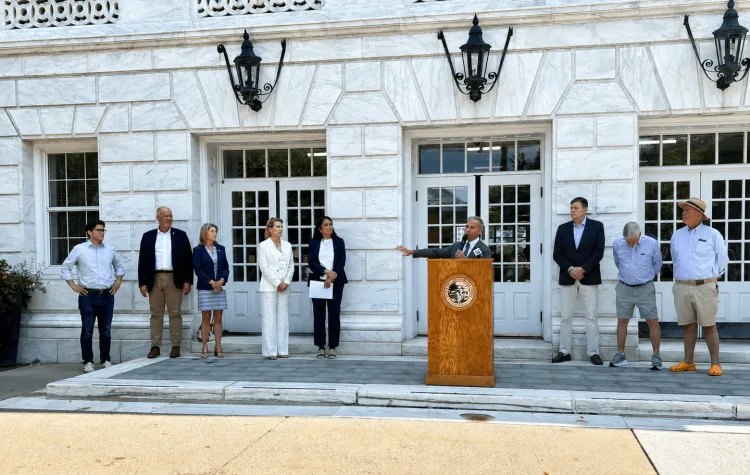
Camillo led a bipartisan, multi-town press conference outside Greenwich Town Hall on Thursday, July 24, calling on Gov. Ned Lamont and the General Assembly to impose an immediate moratorium on state zoning mandates for all Connecticut municipalities.
"Over the past few weeks, several people have come forward," Camillo said. "Once they were done with construction, they were told by one of the utilities that they don't have the capacity to be able to increase service to the expanded homes."
Eight elected officials from Greenwich, Darien and New Canaan stood with Camillo: State Reps. Tina Courpas, Hector Arzeno and Steve Meskers of Greenwich; State Rep. Tracy Marra of Darien, ranking member of the legislature's Energy and Technology Committee; State Rep. Tom O'Dea of New Canaan; State Sen. Ryan Fazio of Greenwich; Darien Selectman Monica McNally; and New Canaan First Selectman Dionna Carlson.
The coalition is targeting House Bill 8002, the omnibus housing law Gov. Lamont signed in November 2025 after the legislature passed it 90-56 in the House and 24-10 in the Senate during a special session. The law requires towns to create housing growth plans, eliminates most minimum parking requirements for smaller developments, and expands fair rent commissions. The group wants the law's mandates frozen for all municipalities until infrastructure catches up.
Courpas called the legislative process behind HB 8002 "undemocratic" and said it "lacked public input." She told the crowd that two utility companies, CNG and Aquarion, "have told our first selectman that they don't have the capacity to serve Greenwich now."
Camillo said representatives from both companies acknowledged capacity constraints during meetings with the town. But State Rep. Steve Meskers offered a different read, questioning whether private utilities have invested enough to keep up with demand. "I'm somewhat surprised that our private sector utilities have not anticipated a five or 10 percent growth rate," Meskers said, calling for discussions about pipeline and pumping station capacity.
Camillo warned the shortfall could jeopardize local affordable housing projects, pointing to Vinci Gardens, a proposed 52-unit senior housing development at 69 Vinci Drive in Byram that Greenwich Communities has planned. "My fear is even those projects, when they find out that they're not going to be able to build them for what they wanted to build them, are those projects going to be stopped?" he said.
Other officials broadened the argument. New Canaan First Selectman Carlson linked the infrastructure strain to recent Fairfield County flooding, saying more hardscape and larger buildings in dense communities "is going to exacerbate those problems." Marra said the state has focused on renewable energy while neglecting overall grid capacity. O'Dea criticized Aquarion for an agreement to supply water to Pound Ridge, N.Y., while southwestern Connecticut faces drought conditions, calling it "outrageous."
Camillo said he wants collaboration with Hartford, not confrontation. "Just building more is not the answer. Building wisely is," he said.
The town is organizing a public forum in September at Greenwich Town Hall with CNG, Aquarion and Eversource, which has not publicly acknowledged similar capacity constraints but serves the town's electric grid. No specific date has been announced. Gov. Lamont's office has not publicly responded to the moratorium demand.