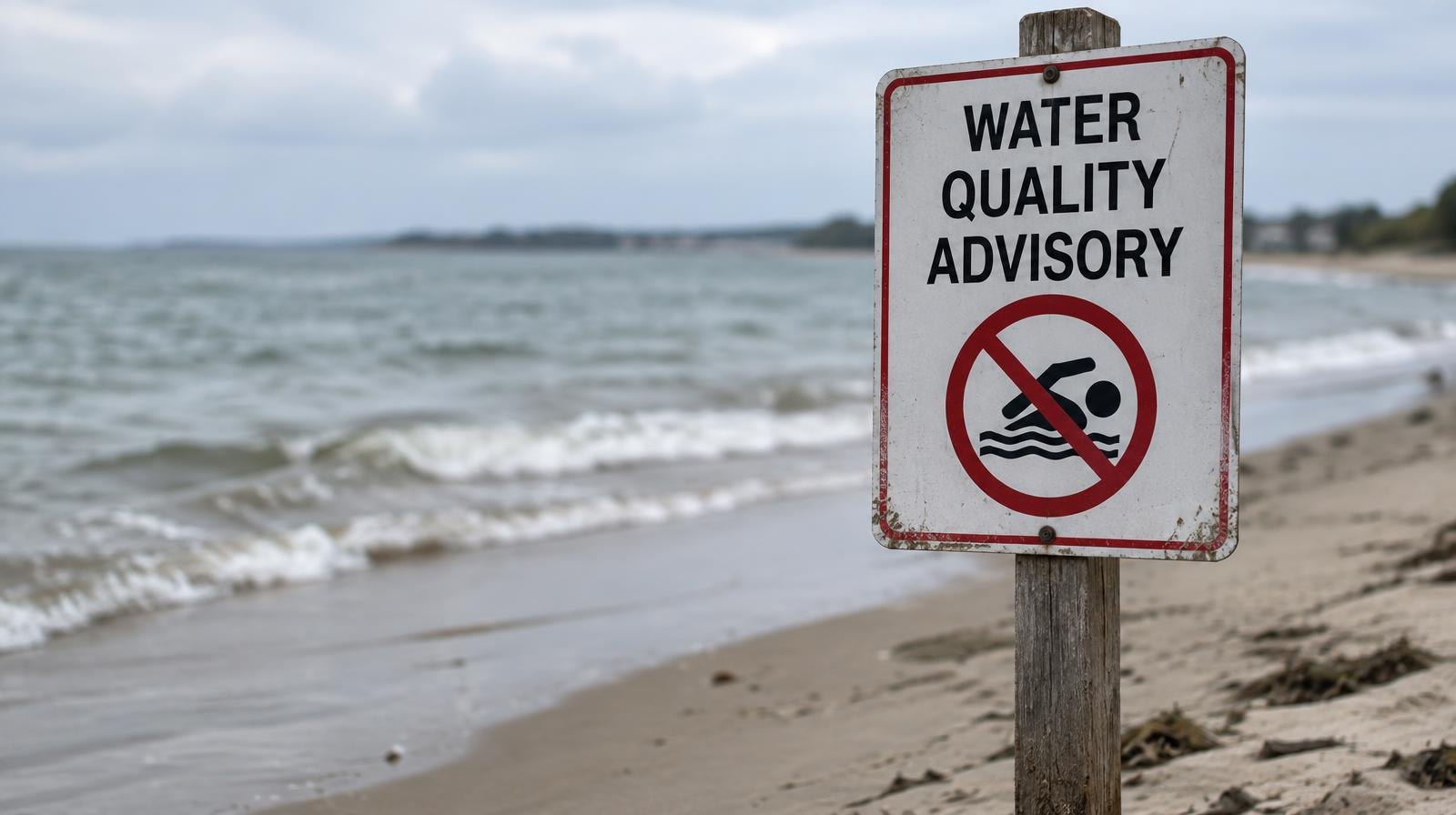
Byram Beach logged 118 bacteria-related closures between 2015 and 2025, even as Long Island Sound's open waters posted their best grades in nearly two decades.
Save the Sound released its 2026 Long Island Sound Report Card on Tuesday, Sept. 22, at Weed Beach in Darien. The nonprofit's annual assessment, based on 2025 monitoring data, found that all five open-water segments of the Sound maintained or improved their grades compared with the previous year.
The standout result: the Western Narrows, the heavily developed stretch near New York City, earned a D. That is the first passing grade for the segment since grading began in 2008, according to Greenwich Time. The segment had received an F every prior year.
Closer to Greenwich, the Eastern Narrows scored a B with an improving long-term trend. The Western Basin, which extends to around Scott Cove in Darien, rose from an A- to an A. Overall, 98% of the Sound's open waters received a B or better.
The Sound also recorded its smallest area of hypoxia since tracking began in 1987. The zone of dangerously low oxygen covered just 18.34 square miles in 2025.
"This is one of the only estuaries on the planet that's getting better," Bill Lucey, Save the Sound's Soundkeeper, said at the Darien event. "Most of them are getting worse."
Save the Sound credited billions of dollars in wastewater treatment plant upgrades across Connecticut and New York, which reduced nitrogen flowing into the Sound, as a leading factor.
Bays tell a different story
Open-water grades do not capture what happens in shallow coastal areas closer to shore. Of the 62 bay segments graded, 56% earned an A or B for overall water quality, but half received a C, D or F for dissolved oxygen. Low dissolved oxygen can slow the growth and reproduction of marine life.
Bay conditions differ from nearby open water because shallow areas absorb more local pollution, including stormwater runoff, aging sewer systems, fertilizer and failing septic systems, Save the Sound said.
That pattern hits home in Greenwich. The Greenwich Tree Conservancy reported that Byram Beach's 118 closures over the past decade stem partly from its sheltered location, which makes it harder for polluted water to clear. Byram and Chickahominy have some of Greenwich's highest population densities and lowest tree canopy levels, factors that increase stormwater runoff.
The town's Beach Water Testing Program runs from Memorial Day weekend through Labor Day for land beaches and through mid-September for Island Beach and Great Captain's Island. After the regular season, the town advises against swimming for one day after 0.3 inches of rain at Byram Beach and after 1.0 inches at Greenwich Point.
Climate risks threaten gains
Elena Colón, laboratory manager at Save the Sound, warned that climate change, population growth and coastal development threaten the progress. Warmer water holds less oxygen, she said, raising the risk of hypoxia.
U.S. Rep. Jim Himes, who attended the Darien unveiling, acknowledged remaining trouble spots, including Bridgeport Harbor, Norwalk Harbor and Holly Pond on the Darien-Stamford border.
Save the Sound said residents can help by limiting fertilizer use, maintaining septic and sewer systems, planting native vegetation and installing rain gardens. The Unified Water Study, launched in 2017, collected data from 27 partner groups in 2025 during its 10th monitoring season. The full report card event is available on DarienTV.